After a very busy (despite the pandemic) Christmas season and a much needed Christmas Break, even I have to admit it has been hard to resume my daily practice routine. Perhaps, I’m writing this post to inspire myself to stay on track as much as I am hoping to motivate others to get back into a progressive routine. Nonetheless, I’ve decided that my daily mantra for 2021 is ‘GO PRACTICE!’
Like everything else in life, the hardest part is getting started. Here are 3 simple steps to help you maintain and organise regular practice on your instrument.
“First you imitate, then you innovate.”
– Miles Davis
Listening is the single most underrated activity that all musicians need more of. Regular listening to a variety of music is equal to immersing oneself in a foreign language. It provides context for phrasing, articulation, styles, tone, harmony and texture. In the words of Miles Davis, “First you imitate, then you innovate.”
There are 2 types of listening.
Passive – commonly referred to as background noise. This kind of listening is what we do whilst driving or doing the dishes. It is often during this kind of listening that we memorize intros or catchy choruses, humming along without actually realizing that we know the piece. Chances are that although you can hum along and even recognize a few lines of the hook but cannot recall how the song starts, the title, who sings it or where you’ve heard the song before.
Active – This is the kind of listening we do when listening to a lecture, TED talk or if we want to memorize a passage. Often, after active listening, we can recall parts of what we were listening to in great detail. This kind of listening is intentional and can be extremely beneficial for musicians, students of foreign languages or speakers preparing for presentation, especially when time constraints may be a concern.
Musicians who are looking to improve their skills should engage in regular PASSIVE and ACTIVE listening. My personal favorite way to do this is to create a playlist for passive listening for my drive to work each week and to actively listen by reading the score while listening a few times before I take my instrument out of its case to practice in the evening.
I openly confess that I read music extremely well and for many years assumed it was just par for the course of being classically trained. A friend once asked how they could improve their reading skills and it caused me to reflect on how I actually mastered the skill. I now realize that my reading skills were developed out of necessity as I was a member in numerous ensembles that required fluent reading but mostly because I spent hours avoiding my lesson assignments by playing hymns and pop songs simply because I enjoyed being able to play songs that I knew and having others sing along. I would purchase new sheet music every weekend like my friends invested in comic books. Today I have shelves of pop music from the 90s and hymnals from just about every denomination. I say all of this to say, include pieces you like in your weekly practice regimen. You can even take it a step further and save these pieces for the end of your routine as reward for the hard work you’ve put in and a way to end you practice session on a good note.
We’ve all heard the old adage, “To Fail to Plan is To Plan to Fail.” In addition to scheduling your practice for the same time each day, set time limits on your practice and create practice environment that is comfortable and distraction free. One of my favorite annual experiences is attending one of the numerous Suzuki Summer Institutes. There are always so many attendees that the practice rooms are booked solid and it is not unusual to see people practicing in a stairwell, under a tree or in the parking lot. There’s no right or wrong place to practice but there are ideal practice conditions.
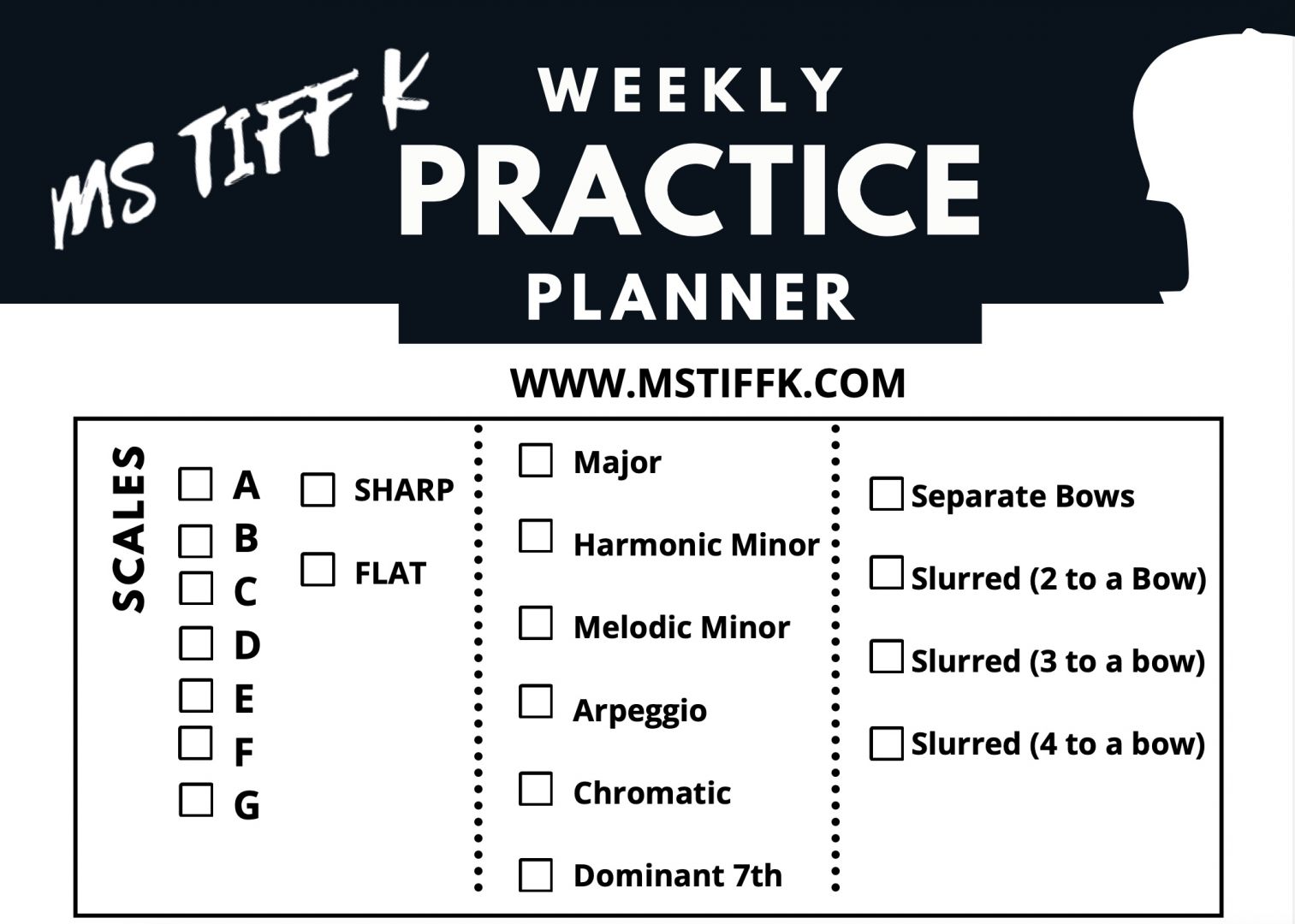
*BONUS TIP: Utilize a practice planner. Just like your listening playlist, you can shuffle it or tweak it each week to focus on whatever you’d like to concentrate on that week. Whether you are studying with a teacher or self-guided, there are a few key elements that you can include in your weekly practice checklist.